

Latest
The Sustainable Development Goals in Palestine
The UN and its partners in Palestine are working towards achieving the Sustainable Development Goals: 17 interconnected Goals which address the major development challenges faced by people in Palestine and around the world. These are the goals the UN is working on in Palestine:
Story
17 July 2025
Gaza war: UN officials warn of unspeakable conditions as children bear the brunt
Top UN officials told the Security Council on Wednesday, warning of soaring child deaths, starvation and a shattered health system amid continuing bombardment and displacement.Tom Fletcher, the UN Emergency Relief Coordinator, said there was no “vocabulary” left to adequately describe conditions on the ground.“Food is running out. Those seeking it risk being shot. People are dying trying to feed their families. Field hospitals receive dead bodies, and medical workers hear stories firsthand from the injured – day after day after day,” he said.Starvation rates among children reached their highest levels in June, with more than 5,800 girls and boys diagnosed as acutely malnourished.“Last week, amid this hunger crisis, children and women were killed in a strike while waiting for the food supplements to keep them alive.”A classroom full of children, lost every dayUNICEF’s Executive Director Catherine Russell told ambassadors that an average of 28 children are killed in Gaza every day – “the equivalent of an entire classroom.”Over the past 21 months, more than 17,000 children have been killed and 33,000 injured across Gaza.Many of those children, she said, were struck “as they line up for lifesaving humanitarian aid – further proof that there is no safe place for civilians anywhere in Gaza.”“Children are not political actors. They do not start conflicts, and they are powerless to stop them. But they suffer greatly, and they wonder why the world has failed them,” she added.“And make no mistake, we have failed them.”Critical infrastructure collapseGaza’s health system “is shattered,” Mr. Fletcher reported – only 17 of 36 hospitals and 63 of 170 primary health centres are even partially functioning; shortages mean up to five babies share one incubator.Seventy per cent of essential medicines are out of stock, half of all medical equipment is damaged, pregnant women are giving birth without care, women and girls manage their periods without basic supplies.Meanwhile, water production capacity has plummeted leaving the entire enclave (95 per cent) facing water insecurity.“With clean water increasingly difficult to access, children have little choice but to drink contaminated water,” Ms. Russell said, noting that this is increasing the risk of disease outbreaks.Aid impeded, fuel at trickle levelsMr. Fletcher further described the scale of challenges to moving something as simple as a bag of flour into Gaza.He noted multiple layers of approvals that Israel requires, scanning, re‑loading, multiple handoffs, damaged roads, delays at holding points, insecurity and desperate civilians grabbing supplies off trucks.Last week – after almost 130 days – some fuel entered Gaza, as Israeli authorities agreed to allow two trucks in per day, five days a week. However, petrol – fuel for ambulances and other critical services – has not been permitted.Between 19 May and 14 July, just 1,633 aid trucks – about 62 per cent of loads submitted for clearance – entered Gaza, far below the average of 630 daily truckloads moved during the previous ceasefire, Mr. Fletcher said.Appeals to Israel, Hamas – and the CouncilBoth officials pressed for immediate, safe, sustained, demilitarised humanitarian access through all available crossings, consistent fuel flows, protection of civilians at distribution points, and restoration of the UN‑led aid pipeline that briefly functioned during earlier pauses in fighting.They also reiterated the UN’s call for the immediate and unconditional release of all hostages held in Gaza and called on all parties – including Hamas and other armed groups – to respect international humanitarian law.Mr. Fletcher asked the Security Council to assess whether Israel, as the occupying power, is meeting its obligations to ensure food and medical supplies reach civilians.“We hold all parties to the standards of international law in this conflict. We don’t have to choose – and in fact, we must not choose – between demanding the end to the starvation of civilians in Gaza and demanding the unconditional release of all the hostages,” he said.“We must reject antisemitism – we must fight it with every fibre of our DNA. But we must also hold Israel to the same principles and laws as all other States.”
1 of 5
Story
18 July 2025
Guterres deplores Israeli strike on Gaza church
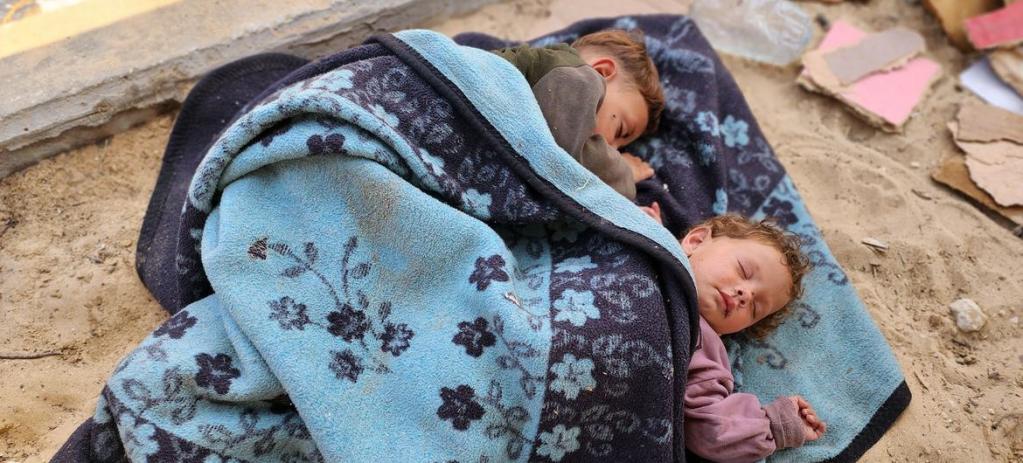
Three people were killed and at least 10 others were injured in the bombing of the Holy Family Church in Gaza City, according to media reports.Stephanie Tremblay, a spokesperson for the Secretary-General, noted that the church was both a place of worship and a sanctuary for civilians.“Attacks on places of worship are unacceptable. People seeking shelter must be respected and protected, not hit by strikes,” she said during the daily media briefing from New York.“Too many lives have already been lost,” she added, before stressing the urgent need for an immediate ceasefire and the immediate and unconditional release of all hostages.Strikes continue amid widespread displacement Meanwhile, Israeli strikes over the past 24 hours have hit sites hosting displaced Palestinians, some of whom were injured and killed.The UN Office for the Coordination of Humanitarian Affairs (OCHA) reported that more than 11,500 people in Gaza were newly displaced between 8-15 July.Overall, more than 737,000 people have been uprooted since the latest escalation of hostilities on 18 March, or roughly 35 per cent of the population.Furthermore, nearly everyone in Gaza has been displaced, in many cases multiple times, since the war began in October 2023.Ms. Tremblay reminded journalists that most housing in Gaza is flattened or otherwise unhabitable and families are staying in the open because the UN has not been allowed to bring in tents and other shelter materials since early March.Mediterranean swimming banShe also highlighted a “worrying development” as humanitarians report that many displaced people are wary of bathing in the Mediterranean Sea after Israel reinstated a ban prohibiting swimming and fishing.“OCHA says that for many, the sea has been their only option to wash, as there is barely any functioning water infrastructure and almost no fuel to pump water, a much-needed outlet in the hot weather in Gaza,” she explained. More fuel neededHumanitarians also continue to report that the amount of fuel Israel is allowing into Gaza is still nowhere enough to keep life-saving services operating and shutdowns are a real risk. Ms. Tremblay mentioned “a small but important step” that occurred on Thursday, as the UN was finally allowed to bring in some benzene – used to power ambulances and other critical services - for the first time in more than 135 days.“That’s in addition to the limited amounts of diesel allowed over the past week. But it’s not enough,” she said.“We are calling for more fuel – both benzene and diesel – to come in regularly. And the ban on shelter materials needs to be lifted immediately. Lives depend on both.”
1 of 5
Story
16 July 2025
Gaza: 875 people confirmed dead trying to source food in recent weeks
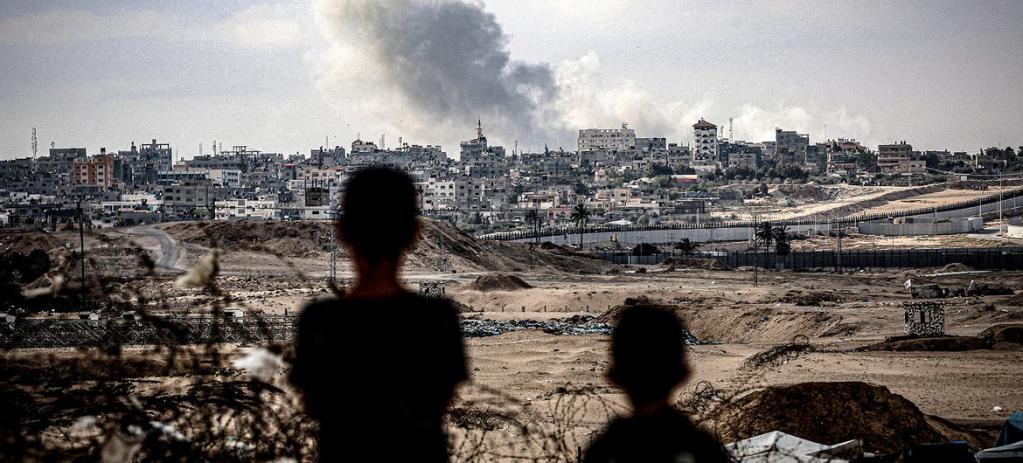
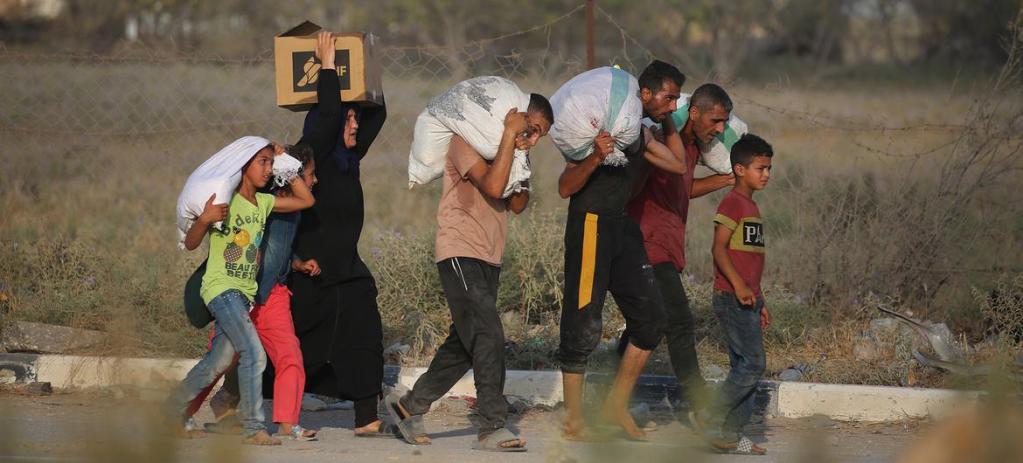
with most deaths linked to private aid hubs run by the so-called Gaza Humanitarian Foundation (GHF), the UN human rights office, OHCHR, said on Tuesday.“As of 13 July, we have recorded 875 people killed in Gaza while trying to get food; 674 of them were killed in the vicinity of GHF sites,” said Thameen Al-Kheetan, OHCHR spokesperson, referencing the US-Israeli run private organization which has bypassed regular humanitarian operations.The remaining 201 victims were killed while seeking food “on the routes of aid convoys or near aid convoys” run by the UN or UN-partners still operating in the war-shattered enclave, Mr. Al-Kheetan told journalists in Geneva.Killings linked to the controversial US and Israeli-backed aid hubs began shortly after they started operating in southern Gaza on 27 May, bypassing the UN and other established NGOs.The latest deadly incident happened at around 9am on Monday 14 July, when reports indicated that the Israeli military shelled and fired towards Palestinians seeking food at the GHF site in As Shakoush area, northwestern Rafah.According to OHCHR, two Palestinians were killed and at least nine others were injured. Some of the casualties were transported to the International Committee of the Red Cross (ICRC) hospital in Rafah. On Saturday medics there received more than 130 patients, the “overwhelming majority” suffering from gunshot wounds and “all responsive individuals” reporting they were attempting to access food distribution sites. Deadly hungerThe UN agency for Palestinian refugees, UNRWA, expressed deep concerns about the continuing killing of civilians trying to access food, while deadly malnutrition spreads among children.“Our teams on the ground - UNRWA teams and other United Nations teams - have spoken to survivors of these killings, these starving children included, who were shot at while on their way to pick up very little food,” said Juliette Touma, UNRWA Director of Communications.Speaking via video from Amman, Ms. Touma insisted that the near-total Israeli blockade of Gaza has led to babies dying of the effects of severe acute malnutrition.“We've been banned from bringing in any humanitarian assistance into Gaza for more than four months now,” she said, before pointing to a “significant increase” in child malnutrition since the Israeli blockade began on 2 March.Ms. Touma added: “We have 6,000 trucks waiting in places like Egypt, like Jordan; it’s from Jordan to the Gaza Strip it's a three-hour drive, right?”In addition to food supplies, these UN trucks contain other vital if basic supplies including bars of soap. “Medicine and food are going to soon expire if we're not able to get those supplies to people in Gaza who need it most, among them one million children who are half of the population of the Gaza Strip,” Ms. Touma continued.West Bank: 'Silent war is surging'Meanwhile in the occupied West Bank including East Jerusalem, Palestinians continue to be killed in violence allegedly linked to Israeli settlers and security forces, UN agencies said.According to OHCHR, two-year-old Laila Khatib was shot in the head by Israeli security forces on 25 January while she was inside her house in Ash-Shuhada village, in Jenin.On 3 July, 61-year-old Walid Badir was shot and killed by Israeli security forces, reportedly while he was cycling back home from prayers, passing through the outskirts of the Nur Shams camp, the UN rights office continued, pointing to intensifying “killings, attacks and harassment of Palestinians in past weeks.“This includes the demolition of hundreds of homes and forced mass displacement of Palestinians,” OHCHR’s Mr. Al-Kheetan noted, with some 30,000 Palestinians forcibly displaced since the launch of Israel’s operation “Iron Wall” in the north of the occupied West Bank earlier this year.“We should recall that international law is very clear about this in terms of the obligations of the occupying power,” he said. “Bringing about a permanent demographic change inside the occupied territory may amount to a war crime and is tantamount to ethnic cleansing.”“We continue to have a silent war that is surging, where heavy restrictions on movement continue, where poverty is increasing as people are cut off from their livelihoods and unemployment soars,” said UNRWA’s Ms. Touma.With its current focus on the northern occupied West Bank, the Israeli military operation has impacted the refugee camps of Jenin, Tulkarem and Nur Shams.“It is causing the largest population displacement of the Palestinians in the West Bank since 1967,” Ms. Touma continued.
1 of 5
Story
15 July 2025
Gaza: UNICEF mourns seven children killed queuing for water
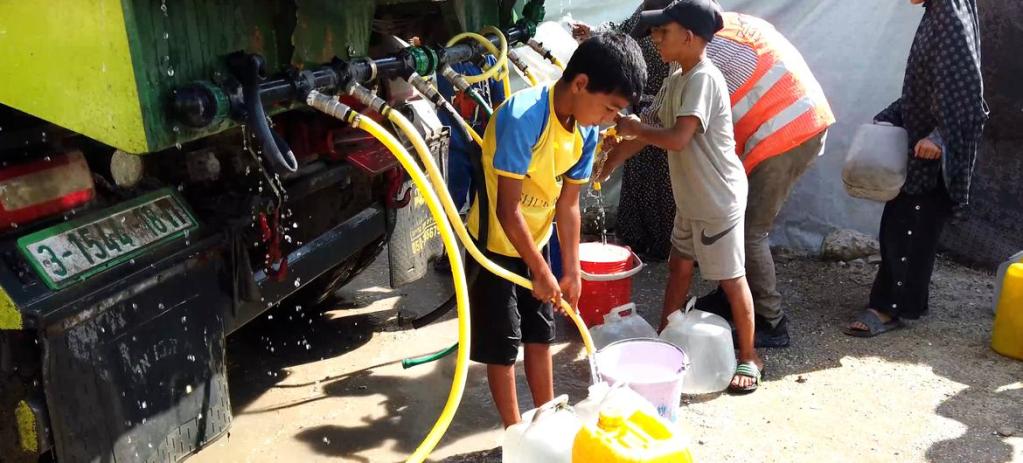
The incident occurred in central Gaza on Sunday, according to media reports, which said that four other people also lost their lives due to the Israeli airstrike. The Israeli military said it had been targeting a terrorist but a “technical error” saw the munition stray off course.Uphold protection of childrenUNICEF Executive Director Catherine Russell noted that the incident came just days after several women and children were killed while lining up for nutritional supplies.“The Israeli authorities must urgently review the rules of engagement and ensure full compliance with international humanitarian law, notably the protection of civilians, including children,” she wrote in a statement posted on X.The UN has repeatedly deplored the killing of Palestinians seeking food aid amid the dire humanitarian situation in Gaza, where food security experts have warned that the entire population, some 2.1 million people, is not getting enough to eat.The risk of famine remains, according to UNICEF. In June, more than 5,800 children were diagnosed with malnutrition, including more than 1,000 children with severe acute malnutrition, representing an increase for the fourth consecutive month. Stockpiles of food availableMeanwhile, “truckloads of food and medical supplies are waiting in warehouses” just outside the enclave, UN Palestine refugee agency UNRWA said in a tweet.It included a quote from one of its health workers who said that “in the past, I only saw such cases of malnutrition in textbooks and documentaries. Today, I am treating them face to face in the health centre.”UNRWA appealed for starvation of civilians to stop and for the siege to be lifted. “Let the UN, including UNRWA, do its lifesaving work,” the tweet said.The small quantities of aid and critical supplies that have entered Gaza so far are nowhere near enough to meet the immense needs, the UN humanitarian affairs office, OCHA, said later on Monday. It called for Israel to allow the urgent entry of aid at scale through all possible routes and corridors. Healthcare under attackOCHA said health teams continue to suffer some of the worst impacts of the hostilities, with the Ministry of Health reporting on Sunday that another doctor had been killed over the previous 24 hours. Although the health system has been decimated and is on the brink of collapse, hospitals continue to respond to mass casualty incidents as much as they can.The Israeli authorities have continued to issue displacement orders amid the ongoing hostilities and destruction, the agency added.On Friday, a displacement order was put out for the Rimal area of Gaza city where some 70,000 people were staying at a dozen displacement sites.Today, more than 86 per cent of Gaza’s territory is either under displacement orders or located within the Israeli-militarized zone. West Bank annexation ‘well underway’Separately, UNRWA also highlighted the situation of Palestinians in the occupied West Bank against the backdrop of the war in Gaza.Agency chief Philippe Lazzarini told an international conference in Switzerland on Monday that “annexation is well underway.”UNRWA said “this is not just destruction: it is part of systematic forced displacement, a violation of international law, and a form of collective punishment.”In January, Israeli forces launched operations in Tulkarm and Jenin in the West Bank, which UNRWA has previously said are the most extensive in two decades.Humanitarians reported last week that the operations are causing massive destruction and displacement while attacks by Israeli settlers have intensified.The high levels of violence continue, with OCHA reporting that two Palestinian men, one of whom was a US national, were killed near Ramallah on Friday during a settler attack.Overall, more than 700 settler attacks have been recorded in the West Bank during the first half of this year. Over 200 communities have been affected, primarily in Ramallah, Nablus and Hebron governorates
1 of 5
Story
14 July 2025
No fuel, no aid, no escape: UN agencies warn of looming collapse in Gaza
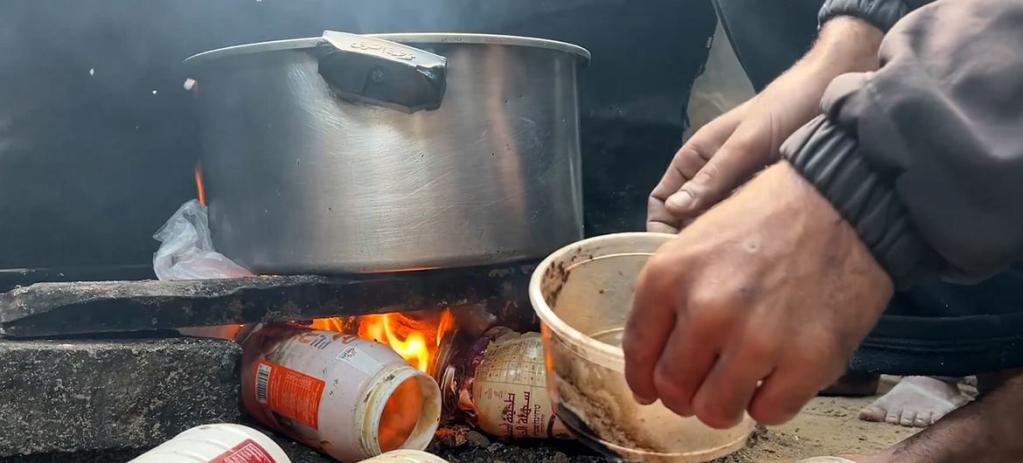
and endangering the lives of everyone reliant on aid inside the enclave, UN agencies warned in a powerful joint statement.“Fuel is the backbone of survival in Gaza,” said the statement. “Without fuel, these lifelines will vanish for 2.1 million people.”UN humanitarian workers stressed that fuel powers everything from hospitals and water systems to bakeries and ambulances.Without a steady supply, “maternity, neonatal and intensive care units are failing, and ambulances can no longer move.” The fuel shortage, they said, has left Gaza’s population – already facing severe food insecurity and the constant threat of violence – on the edge of catastrophe.They warned that “without adequate fuel, UN agencies responding to this crisis will likely be forced to stop their operations entirely,” meaning “no health services, no clean water, and no capacity to deliver aid.”Inadequate fuel injectionThe agencies noted that for the first time in 130 days, a small quantity of fuel was allowed into Gaza this week. While welcome, the amount – just 75,000 litres over two days – is far from enough to meet the daily needs of the population and vital civilian aid operations.Speaking at UN Headquarters in New York late Friday, UN Spokesperson Stéphane Dujarric described the overall situation as “dire and worsening by the day.”“Every day without a ceasefire brings more preventable deaths – children dying in pain, and hungry people shot while trying to reach the trickle of aid that is allowed in,” he said.Life-threateningMr. Dujarric also expressed deep concern over continued Israeli restrictions on aid access. “Yesterday, our teams could provide hospitals with some of the fuel that came in – but only in the south. That’s because Israeli authorities denied our attempt to bring fuel to the north,” he said. “Such denials are life-threatening.”He added that the fuel shortage also affects water treatment, ambulances and waste management. “All of these services are at risk of collapsing,” he said.Out of 15 humanitarian missions that required coordination with Israeli authorities on Thursday, only six were fully facilitated. Five were denied outright, while four faced obstacles that delayed or prevented delivery.One mission, to rescue injured people trapped under rubble in Gaza City, was only approved two days after the initial request – too late to save lives. “By the time the mission was finally allowed through yesterday, no one was found alive,” Dujarric said.On top of this, essential items like tents and shelter materials have been blocked from entering Gaza for over four months, leaving thousands exposed to the elements.Close callAid workers are also at risk. “Five strikes landed just a few hundred metres from where aid workers were operating this week, including UN staff,” Mr. Dujarric said. No injuries were reported, but several Red Crescent workers were shot while attempting to assist an injured colleague.UN agencies are calling for the immediate and consistent delivery of fuel at scale, and for full, safe access to all parts of Gaza. “The urgency of this moment cannot be overstated,” they said. “Without fuel, Gaza faces a complete collapse of humanitarian efforts.”
1 of 5
Story
11 July 2025
UNICEF deplores ‘unconscionable’ killing of families lining up for aid in Gaza
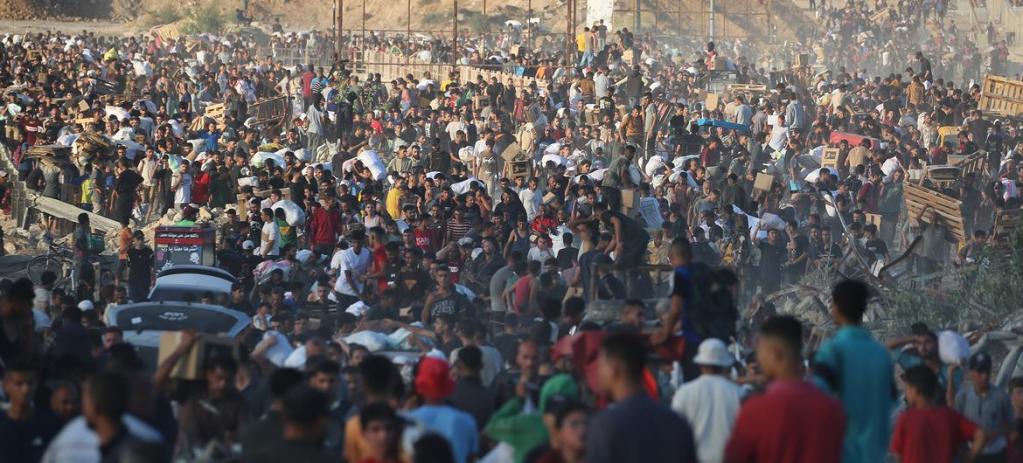
The head of the UN Children’s Fund (UNICEF) has voiced deep dismay over the “unconscionable” killing of children during an aid distribution in the central Gaza Strip. Catherine Russell said she was appalled by the reported killing of 15 Palestinians, including nine children and four women, who were waiting in line for nutritional supplements provided by Project Hope, a UNICEF partner organization.The incident occurred in Deir Al-Balah. An additional 30 people were injured, including 19 children. News reports indicate that it resulted from an Israel strike. ‘Mothers seeking a lifeline’“The killing of families trying to access life-saving aid is unconscionable,” she said in a statement.“These were mothers seeking a lifeline for their children after months of hunger and desperation.”They included Donia, whose one-year-old son, Mohammed, was killed. She reported that the boy had spoken his first words to her just hours earlier.“Donia now lies in a hospital bed, critically injured by the blast, clutching Mohammed’s tiny shoe,” said Ms. Russell. “No parent should have to face such tragedy.”A ‘cruel reality’For the UNICEF chief, “this is the cruel reality confronting many in Gaza today after months of insufficient aid being allowed into the territory, and parties to the conflict failing to uphold basic responsibilities to protect civilians.”She explained that “the lack of aid means children are facing starvation while the risk of famine grows,” warning that “the number of malnourished children will continue to rise until life-saving aid and services are resumed at full scale.”“International law is clear: all parties to the conflict have an obligation to protect civilians and ensure the safe and unimpeded delivery of humanitarian assistance,” she said.“We call on Israel to urgently review its rules of engagement to ensure full compliance with international humanitarian law, notably the protection of civilians including children, and to conduct a thorough and independent investigation of this incident and all allegations of violations.”UN condemns killingsThe UN yet again condemned the killing of civilians in Gaza, Spokesperson Stéphane Dujarric told journalists in New York.Furthermore, the UN humanitarian affairs office OCHA “stresses that parties are bound by international humanitarian law to prevent such excessive death and injury of civilians in the midst of war,” he added.OCHA reported that another strike on Thursday reportedly hit the office of a humanitarian partner in Gaza City. Three staff there were killed. Fuel running outMr. Dujarric also updated journalists on the dire fuel situation in Gaza, which impacts both the population and humanitarians.A UN team managed to bring roughly 75,000 litres of fuel from Israel into the beleaguered enclave on Wednesday, marking the first such provision in 130 days.He warned, however, that fuel is still running out and services will shut down if greater volumes do not enter immediately.Water services at risk“We and our humanitarian partners need hundreds of thousands of litres of fuel each day to keep essential lifesaving and life-sustaining operations going, meaning the amount entered yesterday isn’t sufficient to cover even one day of energy requirements,” he said.One aid partner reported that fuel shortages could soon cut off supplies of clean drinking water to about 44,000 children, he added, which would further increase the risk of cholera, diarrhoea, dysentery and other waterborne illnesses. Meanwhile, UN partners providing education services said that between October 2023 and this June, 626 temporary learning spaces have been established in Gaza, with 240,000 students enrolled, roughly half of them girls. However, only 299 spaces are currently operational due to the ongoing displacement orders, funding shortfalls and other challenges.Aid workers also going hungryHumanitarian partners in Gaza – who include first responders, health workers, and aid workers – “continue to deliver food and other assistance under intolerable conditions, and they themselves are facing hunger,” said Mr. Dujarric.“A number of our own colleagues are also facing hunger. They also face water scarcity and threats to their personal safety, just like everyone else in Gaza,” he added.The Spokesperson reiterated the UN’s long-standing message that “this catastrophic situation must end.” He stressed that “a ceasefire is not only urgent, it is long overdue,” while also calling for the unconditional and immediate release of all hostages. West Bank operationsMr. Dujarric also addressed the situation in the West Bank, where humanitarians report and continue to warn of the intensification of Israeli operations in the northern areas.“These operations are causing massive destruction, driving further humanitarian needs and dampening hopes of thousands of displaced families that they will eventually be able to go back home,” he said.“Meanwhile, attacks, harassment and intimidation by Israeli settlers against Palestinians have become a daily reality.”He cited a settler attack on 3 July that led to the displacement of the Mu’arrajat East Bedouin community in the central West Bank. “This is the ninth community to be fully displaced in the Ramallah and Jericho areas since January 2023 following the recurrent attacks by Israeli settlers.”
1 of 5
Story
09 July 2025
Gaza: Hospitals rationing critical supplies, ambulances stalling
UN humanitarians have warned that the catastrophic conditions in Gaza are worsening, as tents, schools, homes and medical facilities come under attack, and fuel supplies run out. What little fuel remains is powering essential operations, but it is running out fast, and there are virtually no additional accessible stocks left, UN Spokesperson Stéphane Dujarric said, citing reports from the UN relief coordination office, OCHA. “Hospitals are rationing. Ambulances are stalling. Water systems are on the brink. And the deaths this is likely to cause could soon rise sharply unless the Israeli authorities allow new fuel to get in,” said Mr. Dujarric.“We need fuel urgently and we need it in large quantities to power the most essential parts, notably water desalination, hospitals and telecommunications,” he added, noting fuel has not entered the enclave in the last few months.Khan Younis displacementMeanwhile Israeli forces continue to attack civilian infrastructure in Gaza and issue new displacement orders.On Tuesday, such orders were issued for parts of Khan Younis, specifically ordering those staying in tents to move, Mr. Dujarric reported.The map published alongside the order indicates that some areas included had not been subject to displacement orders since before the March ceasefire, he said.“The issuance of a displacement order does not relieve any party from the imperative to spare civilians, including those who are unable or unwilling to move.” Safeguard hospitalsMr. Dujarric also reiterated the UN World Health Organization’s (WHO) call to protect the Nasser Medical Complex in Khan Younis, warning that the hospital is overwhelmed with trauma injuries at double its capacity. In a video message sent from the hospital on Monday, Rik Peeperkorn, WHO representative in the Occupied Palestinian Territory, said the facility is running critically low on trauma supplies, essential medicines, equipment and fuel, and that staff are exhausted.Humanitarian movementsMeanwhile, OCHA reported that humanitarian movements inside Gaza remain heavily restricted: only four out of 12 attempts on Monday to coordinate movements with the Israeli security authorities were fully facilitated, and just one delivered supplies.Four more attempts were rejected by Israeli authorities, halting efforts to evacuate patients, retrieve disabled trucks or clear debris. Although the remaining four were initially approved, ground-level impediments ultimately undermined the ability to carry out the missions.
1 of 5
Story
07 July 2025
UN chief ‘appalled’ by worsening Gaza crisis as civilians face displacement, aid blockades
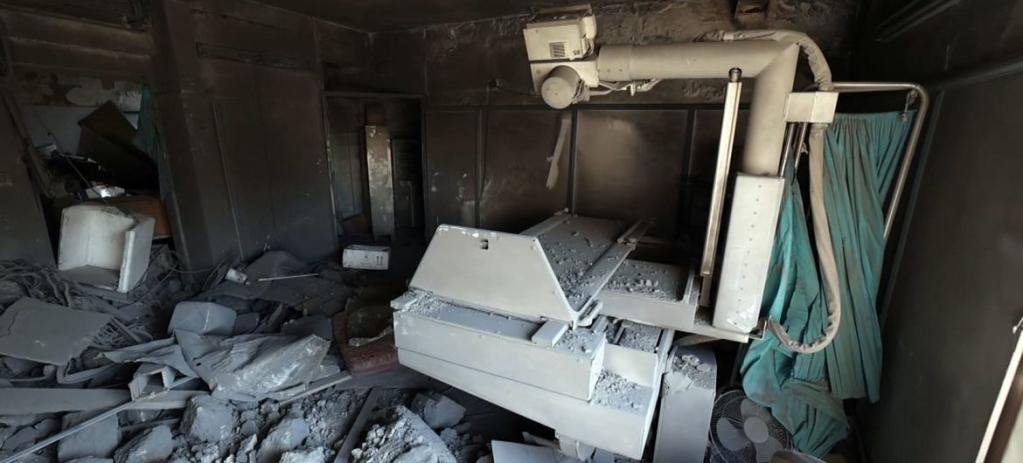
Multiple attacks in recent days have killed and injured scores of Palestinians at sites hosting displaced people and others attempting to access essential supplies, according to a statement from UN Spokesperson Stéphane Dujarric on Thursday.“The Secretary-General strongly condemns the loss of civilian life,” Mr. Dujarric said.On just one day this week, nearly 30,000 people were forced to flee under new Israeli relocation orders, with no safe place to go and clearly inadequate supplies of shelter, food, medicine or water, he added.Critical systems shutting downWith no fuel having entered Gaza in over 17 weeks, the UN chief is also “gravely concerned that the last lifelines for survival are being cut off.”“Without an urgent influx of fuel, incubators will shut down, ambulances will be unable to reach the injured and sick, and water cannot be purified,” Mr. Dujarric said.“The delivery by the United Nations and partners of what little of our lifesaving humanitarian aid is left in Gaza will also grind to a halt.”The Secretary-General reiterated his call for safe and sustained humanitarian access so aid can reach people in desperate need.“The UN has a clear and proven plan, rooted in the humanitarian principles, to get vital assistance to civilians – safely and at scale, wherever they are,” Mr. Dujarric said.The Secretary-General reiterated his call for an immediate and permanent ceasefire and the unconditional release of all hostages held by Hamas and other groups. He reminded all parties that international humanitarian law must be upheld.Displacement continuesDisplacement remains relentless. On Wednesday, Israeli authorities issued a new evacuation order in parts of Gaza City, affecting some 40,000 people and including a displacement site, a medical point and one of the few neighbourhoods that had remained untouched by such orders since before the March ceasefire.Since that ceasefire collapsed, over 50 such orders have been issued, now covering 78 per cent of Gaza’s territory.“Add the Israeli-militarized zones and that percentage jumps to 85 – leaving just 15 per cent where civilians can actually stay,” Mr. Dujarric said, briefing reporters at the UN Headquarters, in New York.Those areas are overcrowded and severely lacking in services or proper infrastructure.“Imagine having just over two million people in Manhattan – which is actually slightly bigger – but instead of buildings, the area is strewn with the rubble of demolished and bombed-out structures, without infrastructure or basic support,” the UN Spokesperson said.“And in Gaza, these remaining areas are also fragmented and unsafe.”
1 of 5

Story
03 July 2025
Gaza: Access to key water facility in Khan Younis disrupted, UN reports
A key water reservoir serving Khan Younis in southern Gaza has become inaccessible following new Israeli displacement orders, sparking fears of a collapse in the city’s water distribution network and worsening already dire humanitarian conditions, the United Nations warned.According to the UN Office for the Coordination of Humanitarian Affairs (OCHA), Israeli authorities issued displacement orders overnight for two neighbourhoods in Khan Younis, where up to 80,000 people had been living.The Al Satar reservoir – a critical hub for distributing piped water from Israel – has become inaccessible as a result.Grave warnings“Any damage to the reservoir could lead to a collapse of the city’s main distribution of the water system, with grave humanitarian consequences,” UN spokesperson Stéphane Dujarric told reporters at a daily news briefing in New York.Al Satar's disruption comes as Gaza’s infrastructure buckles under relentless displacement, strained services and critical shortages of fuel and supplies.Approximately 85 per cent of Gaza’s territory is currently either under displacement orders or located within military zones – severely hampering people’s access to essential aid and the ability of humanitarians to reach those in need, OCHA reported.Displacement continuesSince the collapse of a temporary ceasefire in March, nearly 714,000 Palestinians have been displaced again, including 29,000 in the 24 hours between Sunday and Monday. Existing shelters are overwhelmed, and aid partners report deteriorating health conditions driven by insufficient water, sanitation and hygiene services.Health teams report that rates of acute watery diarrhoea have reached 39 per cent among patients receiving health consultations. Khan Younis and Gaza governorates are hardest hit, with densely overcrowded shelters and little access to clean water exacerbating the spread of disease.Adding to the crisis, no shelter materials have entered Gaza in over four months, despite the hundreds of thousands of newly displaced people. UN partners reported that in 97 per cent of surveyed sites, displaced families are sleeping in the open, exposed to heat, disease and trauma.Fuel shortagesMeanwhile, fuel shortages are jeopardising the humanitarian response. A shipment of diesel intended for northern Gaza was denied on Wednesday by Israeli authorities, just a day after a successful but limited delivery to Al Shifa Hospital in Gaza City.If the fuel crisis is not urgently addressed, Mr. Dujarric warned that relief efforts could grind to a halt.“If the fuel crisis isn’t addressed soon, humanitarian responders could be left without the systems and the tools that are necessary to operate safely, manage logistics and distribute humanitarian assistance,” he said.“This would obviously endanger aid workers and escalate an already dire humanitarian crisis.”
1 of 5
Story
02 July 2025
Gaza: Families deprived of the means for survival, humanitarians warn
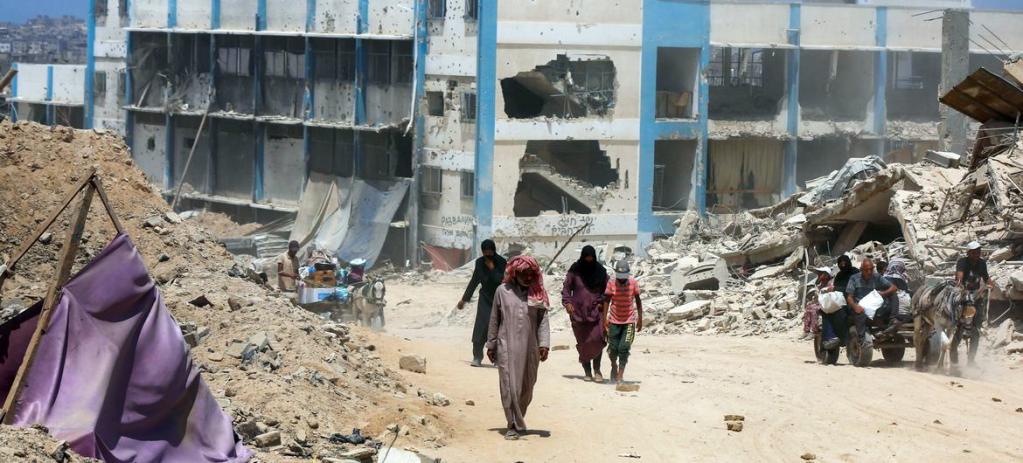
The United Nations reported that humanitarian operations in Gaza are facing escalating strain, as ongoing fuel shortages, access restrictions and military activity continue to undermine aid delivery and essential services. “As humanitarian assistance and basic services dwindle, people in Gaza have been increasingly deprived of the means for their survival,” UN Spokesperson Stéphane Dujarric told reporters at the UN Headquarters in New York.It has been 17 weeks since any fuel has entered Gaza, according to Mr. Dujarric – a critical shortage that forced the Al-Shifa Medical Complex to suspend its kidney dialysis services and restrict its intensive care unit services to just a few hours per day.Other hospitals, including Al-Aqsa in Deir al-Balah, have also come under attack, with the World Health Organization (WHO) reporting a strike on a tent sheltering displaced civilians in its courtyard.Over the past 48 hours, five school buildings sheltering displaced families were also hit, reportedly causing deaths and injuries, while a new evacuation order issued on Sudan displaced 1,500 families from northern Gaza. Living in terrorOlga Cherevko, an official at the UN Office for the Coordination of Humanitarian Affairs (OCHA), described conditions for families in Gaza as “living in terror.”“The only thing that is on their minds right now is a ceasefire and peace at last,” she said. Ms. Cherevko called for Israel to open all border crossings and allow a steady and sufficient flow humanitarian aid.“The thing that needs to happen for us…to address the emergency on the ground, is to reopen additional crossings, to allow supplies to enter through multiple corridors and remove the constraints that are in place for us to deliver supplies to people in need,” she said. She warned that unless conditions change quickly, essential services will continue to shut down — and the broader humanitarian response could stall entirely.“If the situation doesn’t change very, very urgently, more such services will continue shutting down,” Ms. Cherevko said.“And if the situation doesn't change going forward, the entire humanitarian operation could grind to a halt.”
1 of 5
Press Release
07 July 2025
Israeli settlers, supported by the army, forcibly displaced Palestinian communities from the Jordan Valley in the occupied West Bank
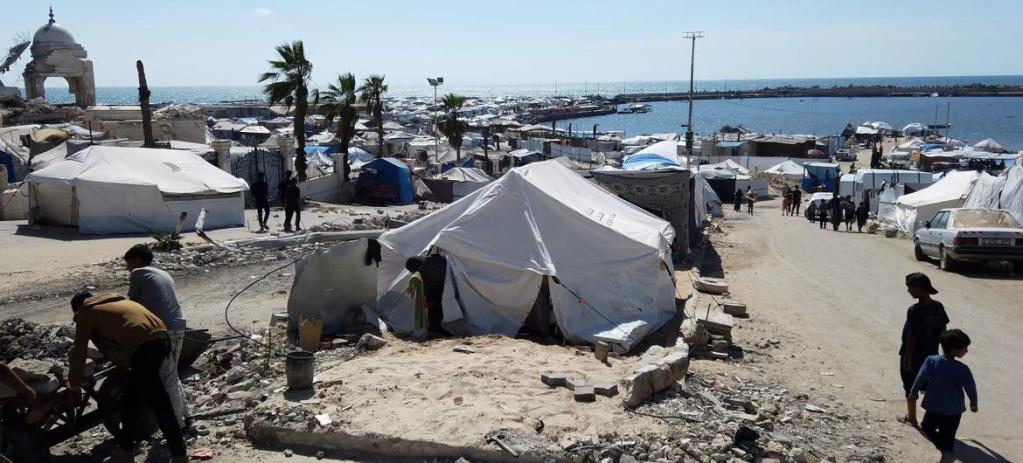
Since 7 October 2023, the community has been gradually surrounded by new outposts and subjected to constant settler attacks. Following the establishment of another new outpost in the middle of the community, on 2 July this year, armed settlers from the nearby "Zohar outpost” stole approximately 60 sheep and harassed the Palestinian residents in their homes. Settlers occupied one of the homes, vandalized it, and forced the residents to leave. Later that night and the day after, the remaining 25 families of the community were also left with no choice but to leave after settlers seized their homes. The land now stands empty of Palestinians. Meanwhile, photos from the site show settlers and soldiers having already taken control of the land. The forcible displacement of this community follows dozens of others over the past months, forming part of a long-standing, state-sanctioned process through coordinated efforts by settlers, backed by the Israeli army, to empty parts of the occupied territory in the West Bank of Palestinians.In the south Hebron Hills, since January this year, Israeli settlers from the Carmel settlement, with the support of soldiers, have been encroaching on land belonging to the Palestinian community of Umm Al Khair. This encroachment — reportedly to establish a so-called “buffer zone” — has involved fencing off large areas of land and denying Palestinian residents access to pasture for livestock. On 29 June, an armed settler, again backed by Israeli soldiers, entered the community with his flock, seized a plot of land adjacent to a Palestinian home and declared it as his own. Since then, the same settler has harassed the community on a daily basis, attempting to enter their homes and intimidate residents.These incidents form part of the ongoing annexation of territory, forcible transfer of Palestinians, and the transfer of Israel’s own civilian population into the Occupied Palestinian Territory. Such forcible transfers amount to a war crime, and a crime against humanity if committed as part of a widespread or systematic attack directed against any civilian population, with knowledge of the attack.
1 of 5
Press Release
02 July 2025
Justice actors in Palestine sign MoU to ensure early legal representation for Juveniles
The MoU ensures that children are promptly informed of their right to legal counsel and psychological support and are accompanied by qualified legal professionals and child protection counsellors from their first contact with law enforcement. This commitment is aligned with Article 40 of the Convention on the Rights of the Child (CRC), which guarantees the right of every child alleged as, accused of, or recognized as having infringed the penal law to be informed promptly and directly of the charges, and to have legal or other appropriate assistance. It also reflects the guidance set out in CRC General Comment No. 10 (2007) on children’s rights in child justice, which emphasizes the importance of ensuring legal safeguards and psychosocial support from the earliest stages of contact with the justice system to uphold the child’s best interests and prevent secondary victimization.“Ensuring that every child has access to a lawyer from the very beginning of their interaction with the justice system is not only a legal safeguard, but also a moral imperative,” said Karin Limdal, Head of Mission, EUPOL COPPS. “This agreement sets a strong foundation for accountability and due process. It’s considered a big milestone toward implementing the right to early legal representation for all suspects in Palestine. EUPOL COPPS believes this fundamental right is essential for strengthening the justice system and upholding fair trial guarantees.”The agreement outlines the responsibilities of each institution to ensure that both legal and psychosocial support are available from the outset. It stipulates that children shall not be questioned or asked to provide a statement before the arrival of a lawyer, except in limited, urgent cases.Under the MoU, child protection counsellors from the Ministry of Social Development will be engaged during the early phases of legal procedures to provide psychosocial support and help guide children and their families through the process. The Palestinian Bar Association will ensure the timely assignment of legal representation, while the Public Prosecution will coordinate and oversee the implementation of the agreement.The agreement also outlines mechanisms for documentation, inter-agency coordination, and training of relevant professionals, helping to ensure consistent and rights-based practices across the justice and child protection sectors.Supported by EUPOL COPPS and the Sawasya III Joint Programme through UNICEF, the signing of this MoU marks a key milestone in justice reform efforts in Palestine. Grounded in national law and aligned with international human rights obligations, it aims to uphold the rights of the most vulnerable — children — from the outset of legal proceedings. “This agreement is a major step forward in reinforcing legal safeguards for children and ensuring that no child goes through the justice system alone. We affirm our strongest belief that children should be protected by restorative justice and alternative to detention mechanisms,” said Simon Ridley, the Sawasya Joint Programme Manager. “It reflects the collective commitment of national institutions to uphold the best interests of children and to guarantee their right to legal protection at all stages of the justice process.”
1 of 5
Press Release
30 June 2025
Gaza: Israel continues to kill entire displaced families in area it designated as “safe”
Since the ceasefire ended on 18 March 2025, the Israeli military has intensified its operations in Rafah and Khan Younis, forcing civilians into ever-shrinking spaces. Between 18 March and 16 June, the Israeli military issued 21 such displacement orders to Palestinians in Rafah, most parts of Khan Younis, and in some parts of southern Middle Gaza.Al Mawasi, located in western Khan Younis, covers approximately 8.9 square kilometers. It is almost completely empty lacking basic infrastructure, such as shelter, water and sewage systems, solid waste removal, latrines, and medical facilities. Despite this, the Israeli military had unilaterally designated the area as a “humanitarian zone” and refers to it in displacement orders as an area of “known shelters”. The Shelter Cluster, working under the UN Humanitarian Country Team, and its partners have repeatedly called for Israel to facilitate the access and entry of supplies to Gaza that are urgently required for the construction of shelters to meet the needs of the increasing number of civilians who are being forcibly displaced. Israel is obliged under international humanitarian law to ensure adequate and safe shelter for internally displaced people, as well as access to food, water, and medical care, until they can return to their homes. Regrettably, in the 21 months since the first orders instructing civilians to relocate, Israel has not made any efforts to comply with its obligations as the occupying power to provide proper accommodation to those relocating or to ensure that these removals are done in satisfactory conditions of health, hygiene, safety and nutrition. Since the end of the ceasefire on 18 March 2025, Al Mawasi has been full of displaced Palestinians. Following that, the increasing issuance of displacement orders has seen its population dramatically increase. According to OCHA, it has more than tripled, increasing from 115,000 on 13 March 2025 to 425,000 as of 19 June. Nearly all are living in makeshift tents assembled with very basic materials.Before the war, Gaza was already one of the most densely populated areas on Earth, with around 5,500 people per square kilometer. Today in Al Mawasi, there are more than 47,700 people per square kilometer.Despite instructing civilians to relocate to Al Mawasi, the Israeli military has continued to conduct intense military attacks on the area, notwithstanding the extremely high concentration of civilians per square kilometer. Many of these appear to target directly makeshift tents with deadly consequences for those inhabiting them. Between 18 March and 16 June 2025, the UN Human Rights Office in the Occupied Palestinian Territory recorded 112 attacks killing 380 people, including at least 158 women and children. Among the victims of these attacks, there were 64 cases where entire nuclear families (parents and their children) were killed.Among a number of such reports are the following:On 31 March, the Israeli military struck tents near the Applied Science College in Al Mawasi. We have verified the killings of 3 Palestinians from the Al Akkar family: a 24-year-old woman, a 66-year-old woman and a 3-year-old boy.On 25 March, the Israeli military struck a tent of the Abu Ta'imah family near Al Aqsa University in Al-Ard Al-Tayyiba camp, Al Mawasi. We have verified that 5 Palestinians were killed: a 33-year-old man, his 29-year-old pregnant wife and their 3 children (a 4-year-old boy, a 6-year-old boy and a 7-year-old girl). The Israeli military made no claim regarding the target of the strike, reflecting the pattern of strikes where no military objective is identified, and all those killed must be presumed civilians unless the Israeli military proves otherwise. On 19 May, at around 9 pm, the Israeli military struck a tent of the Kasab family in the vicinity of the Fish Fresh Junction, Al Mawasi. The UN Human Rights office has verified that 7 Palestinians were killed – a 34-year-old woman and 6 of her children (4 girls aged 5, 7, 10 and 13, and 2 boys aged 11 months and 11 years).The Israeli military has not publicly provided justification for any of the 112 attacks on tents recorded by our office. During the same period, the Israeli army did not issue any statements indicating it had targeted members of Palestinian armed groups or any military objectives in specific locations in Al Mawasi. Exceptionally, on 30 May, the Israeli military claimed to have killed “Khalil Abd al-Nasser Muhammad Khatib, a cell commander in Hamas' Al Mawasi battalion” without specifying the location where he was killed. However, despite having information about three incidents that took place in the Al Mawasi area on 30 May, we have not been able to verify that Khalil Khatib was among those killed. Furthermore, the office could not identify any legitimate military objectives in the vicinity where these attacks took place.Such attacks, resulting in the killing of hundreds of Palestinians, raise serious concerns about the intentional targeting of civilians in violation of international humanitarian law. They also starkly demonstrate that nowhere is safe in Gaza, including the Israeli-designated so-called “humanitarian zones”.
1 of 5
Press Release
26 June 2025
Palestinians subjected to increased forced displacement and land grabs in the occupied West Bank, including East Jerusalem
On 18 June, the High Planning Council in the Israeli Civil Administration issued a directive to reject all building and planning permits submitted by Palestinians in Masafer Yatta, South Hebron Hills, in the area referred by the Israeli authorities as Firing Zone 918, on the grounds the Israeli army needs the area for “military training”. In the 1980s, Israeli authorities designated Masafer Yatta, along with other parts of the occupied West Bank, as Israeli “Firing Zones” — one of the tools used by Israel, the occupying power, to confiscate Palestinian land and expand settlements, in violation of international law.Over the past months, Israel has dramatically ramped up home demolitions, as well as the arbitrary arrest and ill-treatment of Palestinians and human rights defenders, alongside intensifying movement restrictions in and around Masafer Yatta, to force Palestinians out. In parallel, Israeli settlers from nearby outposts — built within the same “Firing Zone” but not subjected to eviction — have conducted daily attacks and harassment of Palestinians, including older people, women and children, in order to force them to leave. The recent directive by the Israeli Civil Administration effectively paves the way for the Israeli army to demolish existing structures in the area and expel the approximately 1,200 Palestinians, who have been living there for decades. This would amount to forcible transfer, which is a war crime. It could also amount to a crime against humanity if committed as part of a widespread or systematic attack directed against any civilian population, with knowledge of the attack.Since 7 October 2023 and as of 31 May 2025, 6,463 Palestinians have been forcibly displaced following the demolition of their homes by Israel according to OCHA; a figure which does not include the approximately 40,000 Palestinians displaced from three refugee camps in Jenin and Tulkarem as a result of heavily militarised Israeli operations in northern West Bank since January 2025. During the same period, over 2,200 Palestinians were forcibly displaced by settler attacks and access restrictions.Countless other Palestinian communities are facing the same fate of forced displacement. On 10 June 2025, the Jerusalem municipality reportedly issued demolition notices for the entire village of An Nu’man, which is home to 150 Palestinians. The village, located near Bethlehem, was cut off from the rest of the West Bank by the construction of the Wall and incorporated into Israel’s unilaterally declared boundaries of the Jerusalem municipality. Most of its Palestinian inhabitants were not provided with Jerusalem IDs, effectively rendering them unable to access services in either East Jerusalem or the rest of the West Bank. These demolition notices appear to be another step by Israel to compound the coercive environment and forcibly transfer Palestinians from the village and consolidate the annexation of this land.Palestinians in occupied East Jerusalem also face the ongoing threat of forced eviction from their homes and lands. On 16 and 22 June, the Israeli Supreme Court endorsed the eviction of five Palestinian families — comprising 37 individuals — from their homes in the Batn El Hawa neighbourhood of Silwan. The rulings were based on discriminatory laws that permit Jewish individuals to reclaim property lost in the 1948 war, while denying Palestinians the same rights. In addition, on 11 June the Israel Land Authority issued eviction notices for residencies in Umm Tuba, impacting 150 Palestinians, who were informed that the land was registered to the Jewish National Fund under the “settlement of land title”. These evictions form part of a concerted campaign by the Israeli State and settler organisations, which target Palestinian neighbourhoods to seize Palestinian homes and expand Jewish settlements. Such acts violate international law, which prohibits the confiscation of private property in occupied territory and the annexation of such territory, as highlighted by the Advisory Opinion of the International Court of Justice last July.
1 of 5
Press Release
02 June 2025
Gaza: Israeli Military Kills 32 Palestinians Seeking Food Aid as 'Militarised Humanitarian Mechanism' Deepens Crisis
In the early morning of 1 June, the Israeli military reportedly shot at Palestinians trying to reach the aid distribution points in northwestern Rafah. According to the Gaza Ministry of Health, there were over 200 Palestinian casualties, including 31 killed and dozens seriously injured. Around the same time, in a similar incident close to another distribution point south of the Netzarim corridor in Middle Gaza, at least 1 person was shot and killed, and 42 were injured. While more information is being gathered, in both locations, the casualties reportedly include children and women.The killings today follow numerous reports of the lethal use of firearms against Palestinians approaching GHF distribution points in Rafah and Middle Gaza since this new mechanism was established late last month. Between 27 and 31 May, the UN Human Rights Office in the Occupied Palestinian Territory (OPT) had already recorded daily violence connected with the mechanism, including reports of at least 19 Palestinians killed and 80 injured in total. At least 2 Palestinians were reportedly missing.The UN Human Rights Office OPT stresses once more that Israel’s militarised humanitarian assistance mechanism violates international standards on aid distribution, endangers civilians, and is contributing to the catastrophic situation in Gaza. The 20 months of hostilities, Israel’s destruction of civilian infrastructure across Gaza, the almost 3 months of complete siege and blockade of Gaza, attacks on community kitchens, as well as the unlawful targeting of civilians including the police force, have led to a break down in civil order and is forcing on Palestinians the stark choice of dying from starvation or risk being killed while trying to access the meagre food that is being made available through the GHF.The weaponisation of food for civilians and restricting or preventing their access to other life-sustaining services constitute a war crime and may constitute elements of other international crimes, including genocide.Israel, as the occupying power, has the duty, to the fullest extent of the means available to it, to ensure the provision of food and medical care for the population commensurate with their needs. They have further obligations to facilitate access by international humanitarian service providers and to facilitate the access of the civilian population to that assistance. The Office recalls that in 2024 the International Court of Justice, having found that there was a real and imminent risk of irreparable prejudice to the plausible rights of Palestinians in Gaza under the Genocide Convention, issued binding orders on Israel to take all measures to ensure, without delay, and in cooperation with the UN, the unhindered provision at scale of aid and assistance to Gaza.As a matter of urgency, Israel must immediately comply if further unnecessary deaths of Palestinian civilians are to be prevented.
1 of 5
Latest Resources
1 / 11
Resources
18 February 2025


Resources
20 September 2022
1 / 11